Machu Picchu and Salkantay Trekking 4 days Adventure
This express version of the Salkantay adventure is suitable for anyone with limited vacation time. The hardest part is on day two due to our ascending at 4630 m / 15190 ft to the Salkantay Pass. You will arrive to Machu Picchu town (Aguas Calientes) on day three and have a guided tour on day four.
This breathtaking adventure in the heart of the Vilcabamba Mountain range will take you through amazing landscapes dominated by snow-capped peaks, crossed by mighty rivers, and populated by ancient traditional villages, until you reach the sacred citadel of Machu Picchu itself.
The 4-day/3-night Salkantay trek to Machu Picchu is challenging yet rewarding and ranks high among Peru and the world’s most spectacular trekking routes.
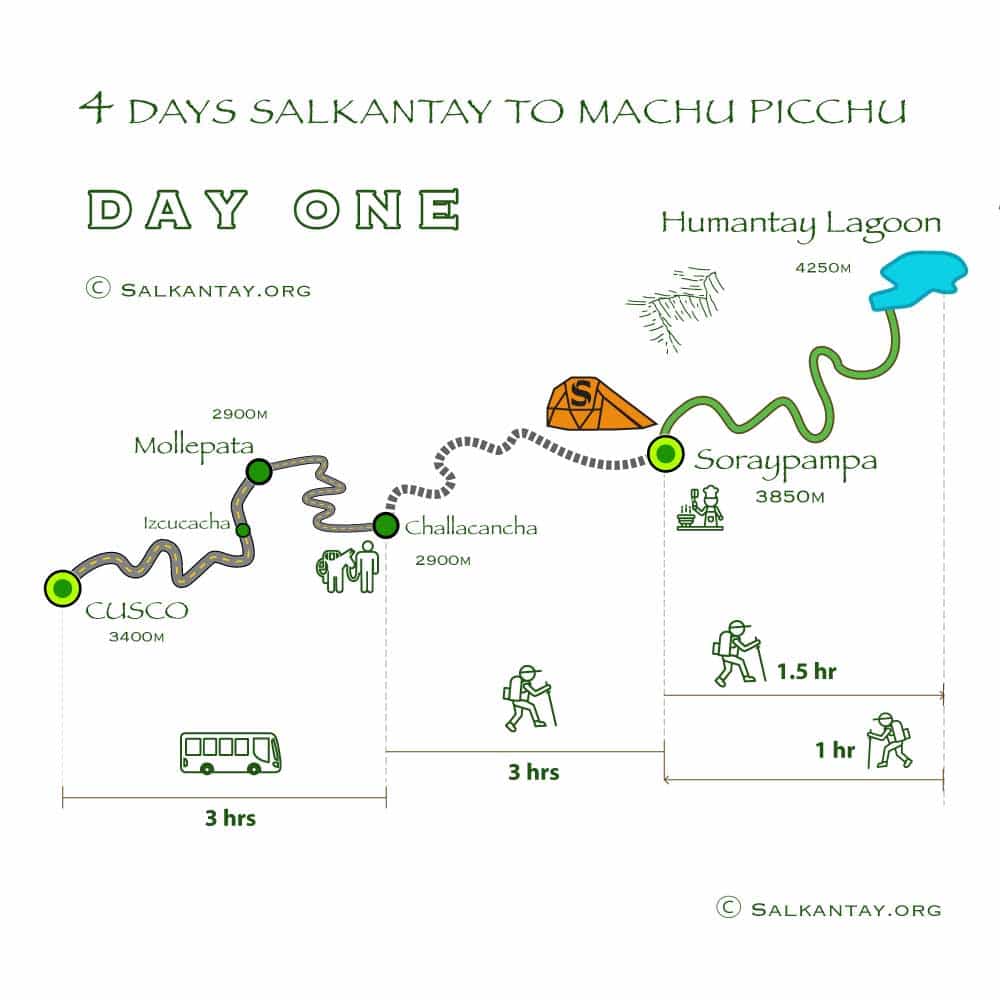
We depart Cusco at around 5:00 a.m. After a three hours bus ride we arrive to the andean town of Mollepata (2900 meters above sea level) where you have the chance to get last minute supplies (e.g. toilet paper, snacks), some leg-stretching and use the restrooms before continuing to our trek starting point at Challacancha (3675 meters above sea level).
At this point we will meet our support staff and load the equipment on horses and mules. Around 9:00 a.m., we will begin our hike toward Soraypampa. On the way we will have a beautiful view of the majestic Salkantay, other snow-covered peaks and the Apurimac Valley. We will have a traditional Peruvian lunch at Soraypampa. After lunch, a relatively moderate hike will take us to the beautiful Humantay Lagoon. We will have time to admire the jaw-dropping landscape of the Andes. Then back to base for snacks and dinner.
Buenas Noches Amigos.
Day 2 — Soraypampa - Wayramachay - Chaullay
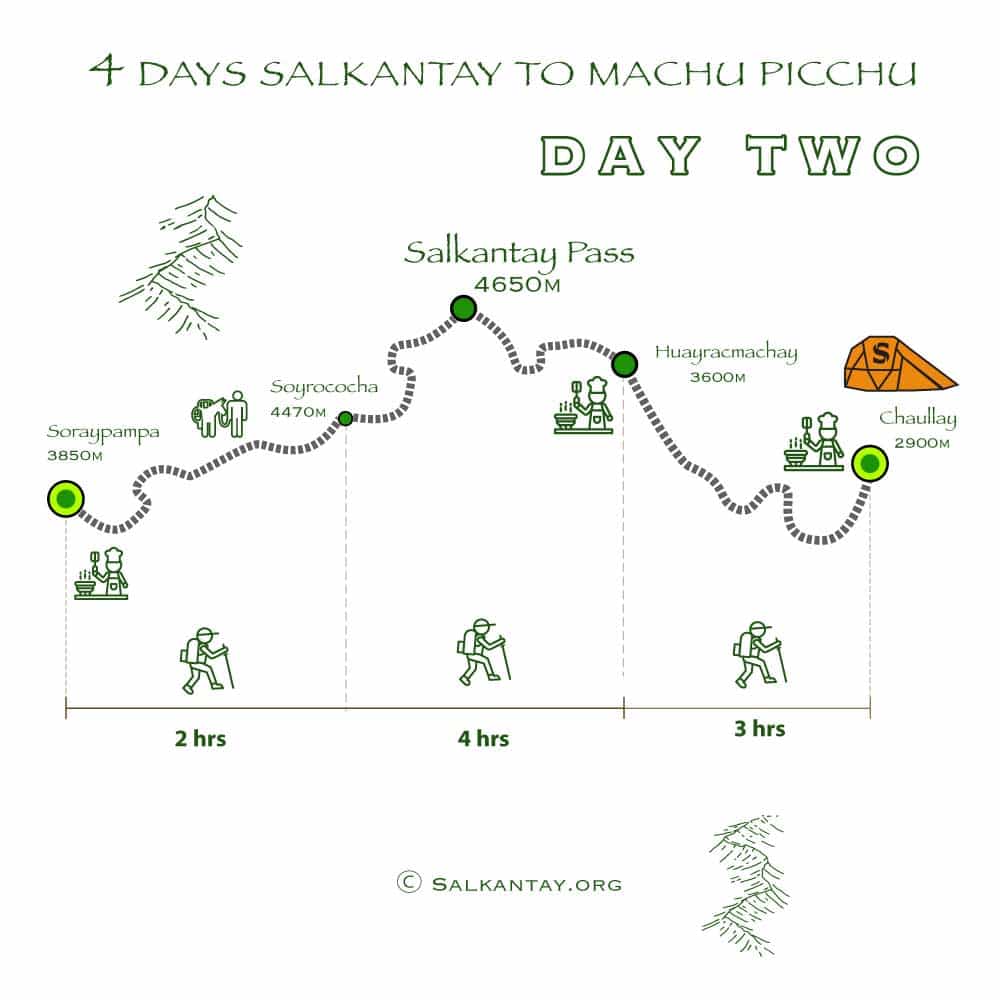
Today, nature will change drastically from dry sceneries to snowy peaks and tropical areas. After a nutritious breakfast, the most difficult part of the trek awaits. We begin today's hike gradually ascending, until reaching the highest point (4630 meters above sea level).
We will appreciate spectacular views of the mountains and the imposing snowy peaks of the Salkantay (6271 meters above sea level) which is known as the second highest peak of the Cusco region. On our way down, we will encounter semi tropical climate. Around 1:00 p.m., we will have our lunch, in the area called Wayramachay (3853 meters above sea level).
After a hike of approximately 3 hours, we will arrive to our camp in Chaullay (2920 meters above sea level). At around 7:00 p.m., dinner will be served.
Buen provecho y a descansar.
Day 3 — Chaullay - Playa Sahuayaco - Machu Picchu Town
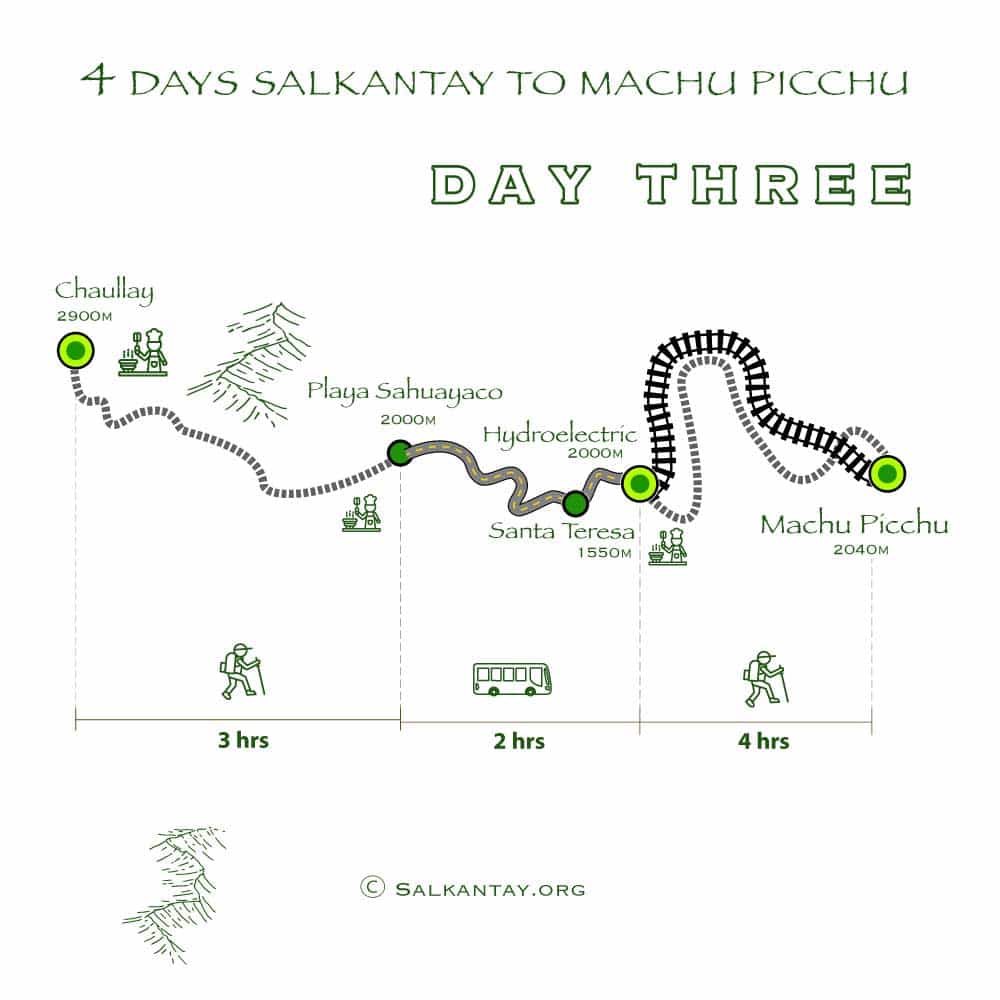
Around 7:30a.m., we will start our trek and enjoy the beautiful sunrise. We will walk for about 5 hours toward Playa Sahuayaco, we will observe a town called Collpabamba, also called the Forest Cloudy Brow where waterfalls, fruit-bearing trees, varied flora, and birds can be observed. If we are lucky, we will be able to observe the famous bird called the 'Rooster of the Rocks'.
Once at Playa Sahuayaco, we will take a local bus to drive us to Santa Teresa where we will have lunch at around 1:30p.m. After lunch, we continue to the Hydroelectric where we will start hiking towards Machu Picchu Town - Aguas Calientes (2040 meters above sea level).
Check-in at the selected hotel and we will have dinner at around 7:00 pm.
Day 4 — Machu Picchu - Cusco
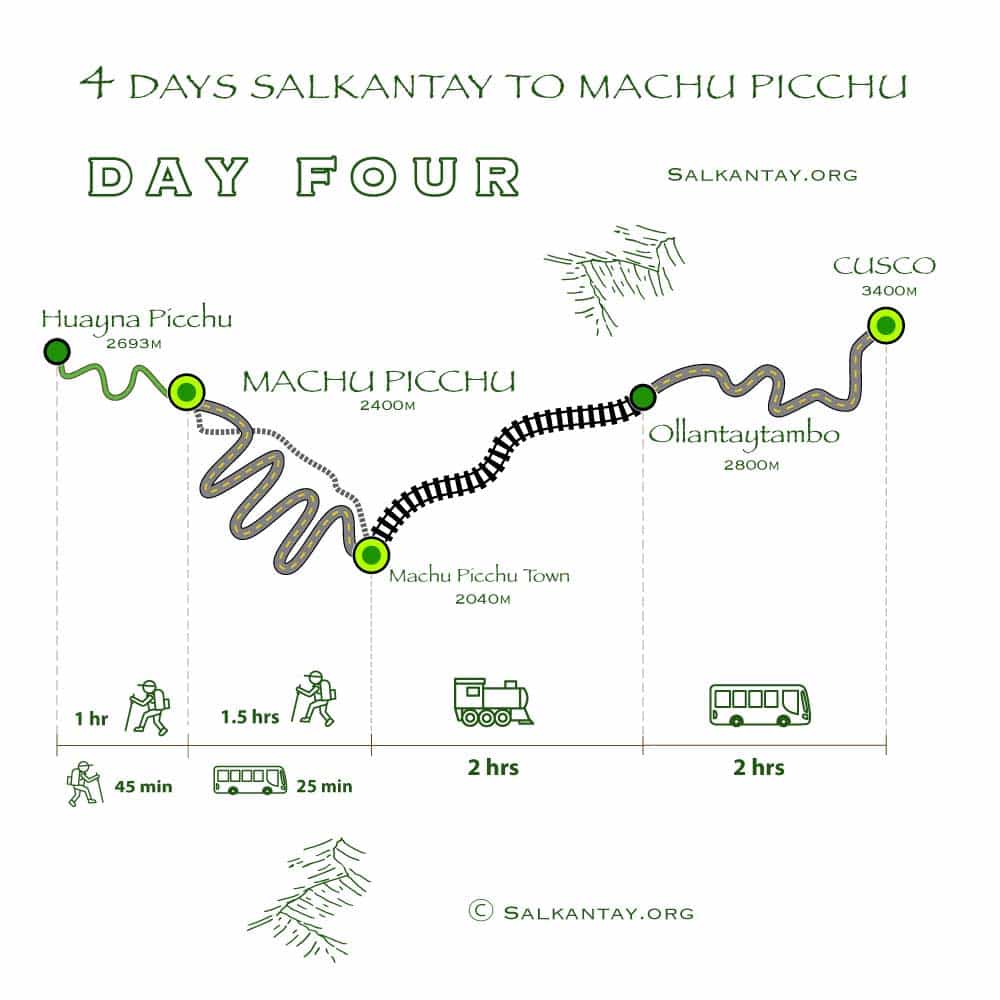
Today, you will start early in order to be one of the first ones at the gate. In Machu Picchu, you will have a guided tour for about two hours. You will be free to explore the Citadel and take more pictures after the guided tour, if you desire, walk up to the Sun Gate or ascent toward Huayna Picchu Mountain (you will need an aditional ticket to access Huayna Picchu).
At your convenience head back down to Aguas Calientes (Machu Picchu Town) and take the train to Ollantaytambo (Normally at 6:20 pm. unless you request a different one).
From Ollantaytambo, a bus will drive you to Cusco.
What's included
Every departure includes the following. Anything marked as not included can usually be rented or added when you book — see what the trek costs for the full breakdown.
Included in the price
Professional Camping Equipment
English-speaking Guides
Mules and Muleteers
All Meals During Trek
Hotel Accommodations in Cusco and Aguas Calientes
Not included
A single supplement of $25 applies if you would prefer your own tent and room.
Check available dates
Departures run year-round with a two-person minimum. Pick a date in the calendar and we
hold the place; there is no permit quota to race.
How to prepare
The second day is the one that tests people: a sustained climb to the 4,630 m pass. Arrive in Cusco two or three days early, walk gently, and drink more water than feels necessary. Our altitude guide explains what acclimatization actually does, the difficulty guide grades the trek honestly, and the packing list covers the five climate zones you cross.
Questions about this trek
How physically demanding is the 4-day Salkantay Trek to Machu Picchu compared to other Andean trails?
The 4-day Salkantay Trek is considered moderately challenging, You'll be hiking 7-8 hours daily across varying terrains, reaching altitudes of 4,630 meters (15,190 feet) at Abra Salkantay pass. This trek is more challenging than the Classic Inca Trail due to steeper ascents and higher elevation. While previous trekking experience isn't mandatory, we strongly recommend establishing a fitness routine 2-3 months before your journey. Regular cardio, leg-strengthening exercises, and practice hikes with a loaded daypack will make your Andean adventure much more enjoyable.
What kind of weather conditions should I prepare for during the Salkantay Trek 4 days expedition in different seasons?
The Salkantay Trek's unique position crossing multiple microclimates means you'll experience dramatic weather variations in a single day! During dry season (May-September), expect cold mornings (possibly below freezing at Salkantay Pass), pleasant daytime temperatures, and chilly nights. The rainy season (November-March) brings afternoon showers and muddier trails, especially as you descend into the cloud forest. Regardless of when you trek, always prepare with layered clothing—thermal base layers, quick-dry hiking clothes, a quality waterproof jacket, and warm accessories for evenings. The mountain weather can change rapidly, so having options to adjust your comfort level throughout the day is essential for an enjoyable trek.
What camping facilities and sleeping arrangements are provided during the Salkantay Trek 4day journey?
Our 4-day Salkantay Trek offers comfortable camping accommodations for the first two nights at Soraypampa and Chaullay, with a cozy hotel stay in Aguas Calientes on the third night. At each campsite, our team sets up quality camping tents appropriate for high-altitude conditions, plus a separate dining tent for meals. We provide thick air sleeping mats for insulation and comfort, though we recommend adding a sleeping bag rental if you don't bring your own. Each morning, you'll receive a clean towel and hot water for personal hygiene. The campsites have basic facilities with cold-water showers, and hot water options available for an additional local fee that supports the communities.
How does altitude acclimatization work for the Salkantay 4 days route to prevent altitude sickness?
Proper acclimatization is crucial for your Salkantay Trek experience since you'll reach 4,630 meters (15,190 feet) at Salkantay Pass! We strongly recommend arriving in Cusco 2-3 days before your trek begins. This gives your body time to adjust to the initial altitude of Cusco (3,400m). During these days, stay hydrated, limit alcohol, eat lightly, and take gentle walks around the city. Our trek design also helps with acclimatization—starting at Mollepata (3,600m) and gradually ascending to Soraypampa (3,900m) on Day 1 before tackling the pass on Day 2. Our experienced guides monitor everyone's condition and carry oxygen cylinders for emergencies. Remember to communicate any symptoms immediately—prevention is always best!
What type of Peruvian cuisine and meals are served during the 4-day Salkantay Trek adventure?
Our 4-day Salkantay Trek features an amazing culinary experience with our skilled mountain chefs preparing authentic Peruvian dishes using fresh, local ingredients! Breakfasts are hearty and energizing—typically including eggs, pancakes, oatmeal, fresh fruits, and coca tea to help with altitude. Lunches and dinners include traditional Andean specialties like quinoa soup, lomo saltado (stir-fried beef), trout, and various potato dishes (Peru has over 4,000 varieties!). We also provide afternoon tea time with snacks to recharge during your trek. Vegetarian, vegan, and special dietary meals are available. All meals are prepared with proper hygiene and served in our comfortable dining tent, creating a wonderful social atmosphere after each day's adventure.
What essential gear and specialized equipment do I need to pack for the 4day Salkantay Trek through changing climates?
For your 4-day Salkantay Trek adventure through multiple microclimates, pack smartly with layered clothing! Essential gear includes: a good daypack (30-40L), broken-in hiking boots with ankle support, thermal base layers, quick-dry pants/shirts, a warm fleece, down jacket, waterproof rain jacket and pants, warm hat and gloves, sun hat, hiking socks (3-4 pairs), and comfortable evening clothes. Don't forget a headlamp, sunscreen (SPF 50+), insect repellent (essential for lower elevations), personal medications, water purification tablets, basic toiletries, and a quick-dry towel. Consider renting our sleeping bags and trekking poles to reduce luggage weight. Remember your camera, portable charger, and some cash for hot showers or additional purchases in local communities!
How do muleteers and mules assist trekkers during the challenging 4-day Salkantay Trek expedition?
Our support team of experienced muleteers with their sturdy mules are truly the heroes of your 4-day Salkantay Trek adventure! These incredible local team members handle all camping equipment, food supplies, and cooking gear—allowing you to trek with just your daypack carrying personal essentials. They'll depart early each morning to ensure camp is fully set up when you arrive at day's end. For those concerned about the physical demands, we offer additional duffel services ($70 for 10kg) to carry your personal items, and even saddle horses for emergency assistance. Our team members are from nearby Andean communities and possess invaluable knowledge of the routes and mountain conditions. We ensure fair treatment and proper working conditions for all support staff—they're an integral part of your authentic Salkantay experience!
What is the best time of year for optimal weather and views on the 4-day Salkantay Trek to Machu Picchu?
The ideal time for your 4-day Salkantay Trek adventure is during the dry season from May to September when clear skies provide spectacular views of the snow-capped Salkantay Mountain (6,271m) and surrounding Andean landscapes. June through August offers the most reliable weather but also brings more trekkers. Consider the 'shoulder months' of April/May or September/October for fewer crowds while still enjoying relatively stable conditions. The rainy season (November-March) transforms the landscape with lush greenery and fewer tourists, but comes with afternoon showers, muddier trails, and occasional fog that may obscure mountain views. February is typically avoided as the wettest month when the Inca Trail closes.
How does the Salkantay Trek 4d route differ from the Classic Inca Trail to Machu Picchu?
The 4-day Salkantay Trek offers a different experience from the Classic Inca Trail while still culminating at Machu Picchu! The Salkantay route traverses more diverse ecosystems—from high alpine terrain at 4,630m to cloud forest—and features dramatic views of Salkantay Mountain (6,271m). Unlike the Inca Trail with its ancient stone paths and numerous archaeological sites, Salkantay showcases raw natural landscapes and fewer ruins. Practically speaking, Salkantay tickets are more readily available, it's less crowded, more challenging physically, reaches higher altitudes, and offers a more rugged, off-the-beaten-path adventure. You'll also experience authentic interactions with remote Andean communities rarely encountered on the Inca Trail. Both routes are incredible—Salkantay simply emphasizes wilderness immersion over historical exploration
What safety measures and emergency protocols are in place during the 4 days Salkantay Trek expedition?
Your safety is our absolute priority throughout the 4-day Salkantay Trek adventure. Our comprehensive safety system includes professional licensed guides trained in wilderness first aid and mountain rescue techniques. Every group travels with a complete first aid kit and oxygen cylinders for altitude-related emergencies. Our guides closely monitor weather conditions adjusting the pace as needed. Before departure, we conduct a thorough briefing covering safety protocols, proper acclimatization, and what to do if you experience difficulties. In case of serious emergencies, we have evacuation procedures using saddle horses for transport to access points where medical assistance can be reached. Our team's experience navigating these routes ensures you can focus on enjoying this magnificent journey with peace of mind!
From the trail log
Walked this route
4.94 / 5 · 187 reviews
“The 4-day express Salkantay Trek delivers everything promised with expert efficiency! Having hiked extensively in the Andes, I appreciated how this itinerary is organized. The guide was great, camping was comfortable, food was excellent, and ending with…”
“We chose the 4-day express Salkantay Trek because of limited vacation time, and it exceeded all expectations! The highlight was undoubtedly the Cocalmayo Hot Springs—arriving there after conquering Salkantay Pass created the perfect contrast between…”
“The four day Salkantay trek was a varied, difficult and rewarding experience. We started with a two day trek up to the Salkantay pass, up a grueling path known as the 'gringo killer' to reach 4600m. We then went down the valley into the rain forest, with…”
From $598 per person · was $639 · two-person minimum
Hold a place on the mountain
Tell us your dates and we will confirm a departure for the 4-day route. Every trek runs with local Quechua-speaking guides and a maximum of 12 trekkers.